Business Growth Strategies
Explore the best customer support platforms, their key features, benefits and how they help businesses improve customer service and satisfaction..
Author
Staff Author
Published
September 12, 2026
Read Time
7 min read

Introduction:
In today’s competitive market, businesses need more than just higher sales to grow and succeed. Creating better opportunities to attract and retain customers, build strong market positions, and improve long-term earnings requires the use of business growth strategies. Whether you have a small business or a large one, a growth strategy shapes your business’s future by helping you identify new growth paths and beat the
competition .Customer experience improvement, footprint expansion, digital and operations improvements, combined with the development of new products or services, can all lead to goals of business growth and sustainability. What strategies you use will depend on what your business values are, your customer base, your available resources, and your competition.
6 Ways to Jump-Start Business Growth:
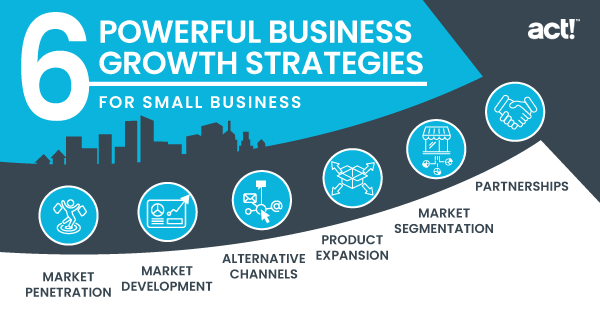
Managing a small business with the traditional frameworks of larger businesses in mind is important, no matter the size of the business or how established it is. Here are six frameworks you can apply to grow your small business immediately.
Market Penetration:
For a small business, growing market share is one of the more achievable methods of growth. This method involves selling more of your current products or services to your existing market without the creation of new products or services.
There are various approaches a business can take to grow market share:
Offer new products or services for either a limited time offer price (free or heavily subsidized), or new services at a limited time offer price.
Sell products in bundles with volume discounts.
Lower prices strategically against competing similar products.
While it may not make sense for a business to offer products and services for a price lower than what it is valued at, price cuts can be an effective growth method for businesses in a highly competitive market, where products and services are similar.
Businesses that are unable to distinguish products and services from competitors need to focus on either matching or beating competing prices in order to improve their market share.
Market Development:
Strategies for Attracting New Customers and Retaining Existing Ones If you retain customers well but struggle to acquire new ones, a market development strategy can lead to new revenue streams without developing a new product. Market development revolves around finding new segments, geographies, or demographics to
sell to .Market development strategies are particularly important in scenarios where sales of existing products stagnate or where there is an adjacent market your business could serve. This strategy may include:
Expanding the business to a new geographic market or region.
Creating a new buyer persona that has a similar need to the existing one but has not been marketed to Adapting an already existing product to a different scenario
A local gym that relies on walk-in members may start offering corporate wellness packages, online coaching, or on-demand videos to audiences outside the current geographical area and expand the business without offering new services.
Alternative channels:
Small businesses often neglect marketing channels and potential leads. Focusing on digital marketing outside of the norm can help increase visibility and lead generation with little additional expense. Small businesses often neglect marketing channels and potential leads. Focusing on
digital marketing outside of the norm can help increase visibility and lead generation
with little additional expense. The primary channels every business should work with:
Email marketing – among the best cost versus returns for small businesses
A website with strong calls to action beyond contact information Presence on social media sites where customers are engaged Beyond the core essentials, reaching customers with a consistent message and presence through omnichannel marketing yields results that surpass traditional
marketing channels. Customers who engage with a marketing effort in multiple channels have more significant long-term value than those engaged with a single channel marketing effort.
Products Expansion:
Product expansion is an important strategy for business growth. Businesses using product expansion draw on new or improved products to reach new customers and grow profits. From a single focus product, businesses can transition to a diverse line of offerings aligned to the customer, market, and demand. A well articulated product expansion strategy can protect and enhance a business’s competitive advantage in the
market, gain new customers, increase brand loyalty and profit. Several product lines can draw an existing product line if businesses perform thorough market analysis and customer demand research before offering new products. New product offerings are critical to long term business profitability.
Market Segmentation:
Businesses can grow by dividing a large target market into smaller segments of customers who share similar interests. For each customer segment, a business can make products and services for that specific segment. Market segmentation attracts the right type of customers, thus increasing sales and customer satisfaction. A company can strengthen relationships with customers that will ensure long term purchase
retention. Segmented marketing helps businesses identify new opportunities and adjust how company resources are allocated in order to foster growth for a business in a sustainable way.
Practical Business Example: Coca-Cola
Coca-Cola is an excellent illustration of market segmentation. Different products and marketing strategies align with differing markets. For instance, Coca-Cola Zero Sugar is offered to customers who prefer a less or no sugar product, whereas regular Coca-Cola is offered to those who prefer the original version. Coca-Cola utilizes different types of advertisements to reach different markets, such as families, kids, and those into sports. Coca-Cola was able to maintain their market share and grow by meeting different
customer demands.
Partnership:
Partnership is another effective business growth strategy that allows two or more businesses to work together to achieve common goals. Adjustable to each scenario, partnerships are one of many growth strategies and allow two or more businesses to align and work toward their desired goals. They require the exchange of resources, employee expertise, available technologies, client base, and marketing access.
Potential benefits of this strategy include the ability to reach new potential clients, the capability to move into a new geographical region, cost advantage, and improved brand exposure. Strong business partnerships have the ability to provide increased product and service offerings without a business having to construct everything through their individual efforts. Overall, the correct business partnership can provide long-lasting results, as well as new business avenues and opportunities.
Practical Business Example: Spotify and Starbucks
An example of a business partnership is the agreement made between Spotify and Starbucks. Spotify’s music program was integrated into Starbucks, and in turn, Starbucks customers could engage with music played in store through Spotify. As a result of this partnership, both businesses were able to access a new audience (through the audience of the partner business). A good example of partnerships allowing a
business to grow and access new audiences. Level of competition, the availability of resources, and the state of the market.
What are the different types of business growth?
It helps to understand all the different types of business growth, how they are classified, and the pros and cons of each type to inform your choice of business growth strategy. The strategy you choose will be influenced by the life cycle of your business, the characteristics of your business, the level of competition, the availability of resources, and the state of the market.
Organic growth includes internal growth options such as branching, and expansion of production capacity. In addition to easing the deployment of technology solutions, these types of growth also provide a lower risk, slower growth strategy ,and provide internal data for process re-engineering and improvement.
In contrast, inorganic growth includes external partnerships, which, if successful, increase production or distribution capacity, size, and competitiveness. Inorganic growth may involve a high level of risk, and include strategies such as a merger or acquisition. More feedback on the quality of goods and services is provided, and, as a result, this type of growth allows the business to become more competitive.
Conclusion:
Growing your business isn’t just about sticking to one plan-it’s about choosing the approach that best fits your goals, market needs, and resources. Things like market segmentation, expanding your product range, and forming strategic partnerships can open doors to reaching the right customers, discovering new opportunities and strengthening your position in the market. When you focus on understanding what your
customers need, stay flexible with market changes, and make smart decisions, your business can grow steadily, boost revenue, and remain competitive over the long term.